What if the goal is not to calm the body down, but to learn what kind of activation is moving through it?
What if the goal is not to calm the body down, but to learn what kind of activation is moving through it?
This is something I find myself returning to again and again in trauma work, EMDR therapy, and somatic practice.
So often, when the body becomes activated, we are quick to assume something is wrong. A fast heart rate, tight muscles, heat in the chest, movement in the legs, or a rush of energy can be interpreted as anxiety, danger, or dysregulation.
And sometimes, of course, it is.
But sometimes it is also effort. Excitement. Play.
Sometimes it is the body remembering that it can climb the hill, meet the moment, and come back to itself.
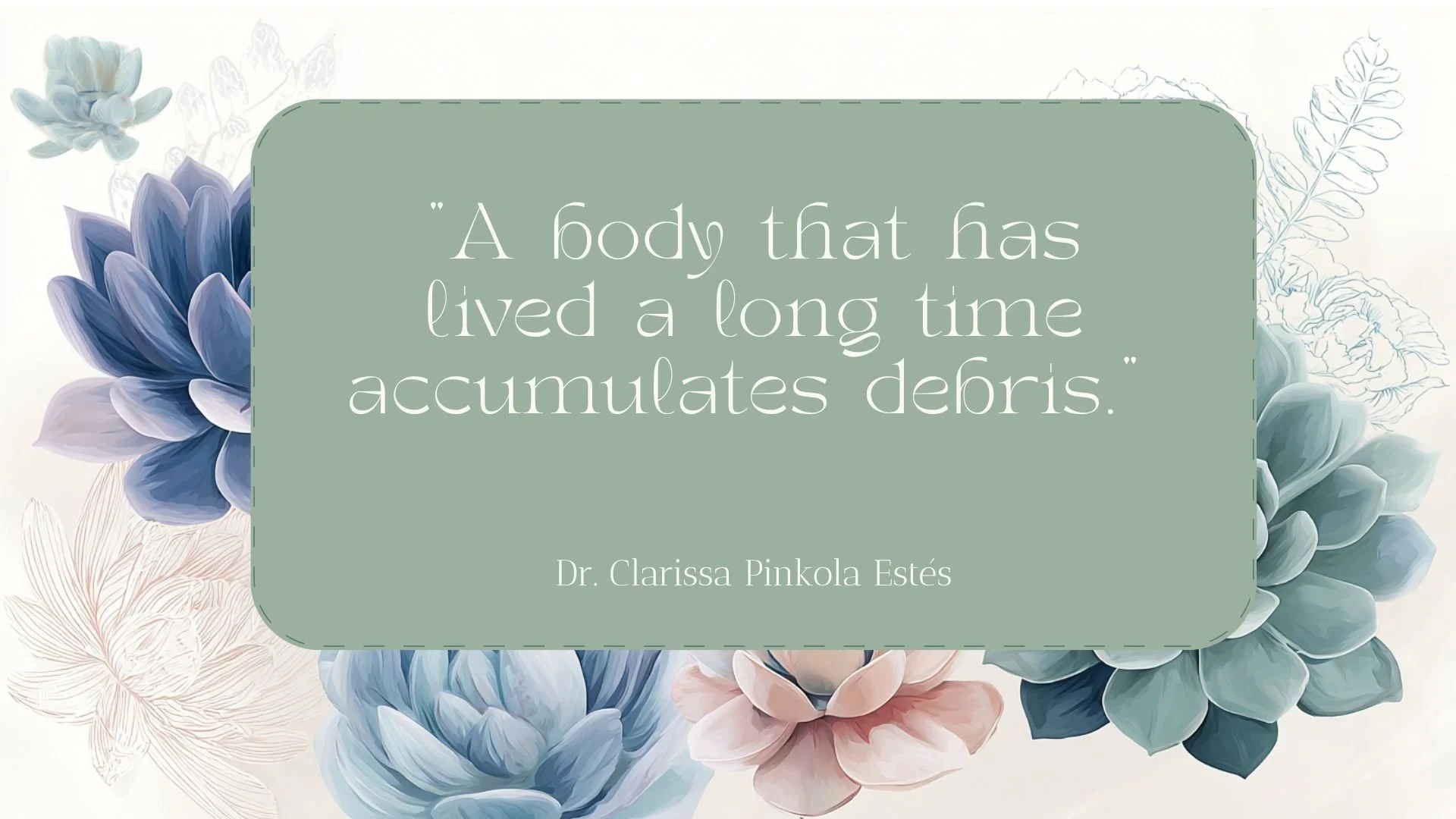
I recently came across a quote from Clarissa Pinkola Estés about how a body that has lived a long time accumulates debris. That line stayed with me because it names something I see so often in the therapy room.
Our bodies carry what we have experienced, the patterns that allowed us to live.
They carry the bracing, the shrinking, the pushing through, the holding back, the scanning, the waiting, and the old adaptations that once helped us survive.
Over time, those patterns can become so familiar that the body begins to organize around them before we even have words, an armor that needs to be worn at all times.
In my work, I often talk with clients and clinicians about the “motor inside.” It is a simple way to explore the body's mobilized states.
When the motor starts running, we get curious instead of fearful or avoidant.
What is moving this?
Is this fear?
Is this urgency?
Is this excitement?
Is this anger?
Is this effort?
Is this aliveness?
Is this an old survival pattern, or is this the body meeting something new?
The difference in all of these matters.
Because in trauma work, activation is not the enemy. The meaning the nervous system has learned to attach to activation is often where the work begins.
I was thinking about this on Friday morning when I woke up early and took Harry for a 7:00 a.m. hike.
The sky was just beginning to lighten. The birds were already awake. The air had that quiet, early-morning feeling that makes the world seem a little softer. Harry and I made our way up a big hill, and when we got to the top, I stopped to rest.

My heart was beating fast.
My breath was full.
My body was working.
And I put my hand on my chest and noticed something important.
My body was activated, but I was not afraid.
My motor was running because I had done something hard. It was running because I was awake, alive, and outside with my dog as the sun came up over the water.
That moment felt important because so much of trauma healing involves helping the body learn this difference.
A fast heart rate does not always mean danger.
Sensation does not always mean threat.
Energy in the body does not always mean something is wrong.
For many trauma survivors, the body has had to organize around danger for so long that even neutral or positive activation can feel unsafe. Excitement can feel too close to panic. Effort can feel too close to collapse. Joy can feel vulnerable. Rest can feel unfamiliar. Aliveness can feel like too much.
This is why somatic work inside EMDR matters.
Not because we need to add a hundred new techniques.
But because we need to help clients build a more accurate relationship with their own body.
We need to support the body in noticing:
This is now.
This is different.
This sensation has more than one possible meaning.
This activation may be old, or it may be something new trying to emerge.
When clients begin to notice these distinctions, they often gain access to a different kind of choice.
They can begin to track the body without immediately fearing it.
They can begin to stay with small moments of goodness a little longer.
They can begin to recognize the edge between overwhelm and capacity.
They can begin to experience mobilization not only as danger, but also as strength, movement, play, and possibility.
This is some of what I will be exploring in my upcoming Somatic EMDR: From Surviving to Flourishing Practitioner Program.
We will look at how the body carries old experience, how those experiences shape present-moment responses, and how clinicians can work with somatic information inside the EMDR framework with more curiosity, care, and clinical intention.
This training is not about replacing EMDR.
It is about deepening our ability to listen to the body within the EMDR process we already know.
It is about helping clients understand the patterns that have protected them, while also building enough safety, choice, and embodied evidence for something new to become possible.
As you move through the rest of your day, I invite you to notice your own motor inside.
Is it running with fear?
With effort?
With excitement?
With care?
With something else entirely?
And if you notice even a small moment where your body is moved by joy, play, or aliveness, maybe let yourself stay there for one breath longer.
The world is hard.
And we still deserve moments where the motor inside gets to run for something good.